Daycare Cleaning Service: What a Good One Covers
A good daycare cleaning service follows a written schedule built on your state’s licensing rules, uses products that are safe around children, and documents every visit. The crew should know the difference between cleaning, sanitizing and disinfecting, and should work after the last pickup so surfaces are ready by morning. This guide covers what to include, how often, which products to look for, and how to judge a provider in Boise, Meridian, Eagle and the rest of the Treasure Valley.
TL;DR
- Cleaning, sanitizing and disinfecting are three different jobs. Surfaces get cleaned first, then sanitized or disinfected, and each task has its own frequency.
- Federal Head Start guidance sets a useful baseline: changing tables after every use, toilet and diapering areas daily, floors daily, toys weekly, carpets steam-cleaned every 3 to 6 months.
- Products should be EPA-registered for sanitizing and disinfecting, ideally fragrance-free or third-party certified, and stored where children cannot reach them.
- Idaho licensed daycares face unannounced annual health inspections, so a cleaning plan you can document matters.
- Price depends on square footage, visit frequency, carpet and the number of deep cleans. Ask for a written scope, not just a rate.
Table of Contents
- Cleaning, sanitizing and disinfecting: the difference that shapes the contract
- What a daycare cleaning routine should include
- How state rules change the plan
- Products and methods that are safe around children
- How to choose a daycare cleaning service
- Perspective
- Cleaning for Treasure Valley childcare spaces with Eagle Ridge
- Building the plan: a simple five-step process
- FAQ
- Sources
Cleaning, sanitizing and disinfecting: the difference that shapes the contract
The three words are not interchangeable, and a cleaning contract that blurs them leaves gaps. The CDC explains that cleaning alone can remove most types of harmful germs, sanitizing lowers germs to levels considered safe, and a surface has to be cleaned before it is sanitized or disinfected, because dirt and residue make it harder for chemicals to work.
In practice that means:
- Cleaning removes visible dirt, crumbs and grime with soap or detergent and water. It covers most floors, shelves, windowsills and furniture.
- Sanitizing lowers germs on surfaces that touch food or mouths: high chair trays, tables, dishes, bottles and mouthed toys.
- Disinfecting targets germs on surfaces that carry body fluids: changing tables, toilets, sinks and potty chairs.
When you hire a team, ask which of these they apply to which surface. A crew that only wipes everything down with one spray is not following the logic that licensing inspectors expect.
What a daycare cleaning routine should include
The Head Start schedule for cleaning, sanitizing and disinfecting is the most widely used national reference. It calls for the following:
- Food preparation surfaces and countertops cleaned and sanitized before and after each use.
- Eating utensils, dishes and bottle-feeding equipment cleaned and sanitized after each use.
- Pacifiers and mouthed toys cleaned before and after each use.
- Classroom toys cleaned weekly.
- Changing tables cleaned and disinfected after each use.
- Toilet and diapering area surfaces cleaned and disinfected daily at the end of the day.
- Doorknobs, handles and light switches cleaned daily.
- Floors cleaned daily at the end of the day, carpets vacuumed daily and steam-cleaned every 3 to 6 months.
- Sheets, blankets and pillowcases laundered weekly at the warmest temperature setting.
Some of these happen during the day and belong to your staff: diaper changes, meal cleanup, mouthed toys. A professional crew handles what happens after hours: restrooms, floors, carpets, trash, high-touch points and deep cleans. Splitting the list this way, in writing, keeps both sides clear about who does what.
Who does what
| Task | Typically handled by | Frequency |
|---|---|---|
| Changing table disinfection | Daycare staff | After every use |
| Mouthed toys, pacifiers | Daycare staff | Before and after each use |
| Restrooms and diapering areas | Cleaning crew | Daily, end of day |
| Floors, trash, high-touch points | Cleaning crew | Daily or on the agreed visit schedule |
| Classroom toy washing | Staff or crew, by agreement | Weekly |
| Carpet steam cleaning | Cleaning crew | Every 3 to 6 months |
| Bedding and cot linens | Staff or crew, by agreement | Weekly |
The frequencies come from the Head Start schedule. Your own state may be stricter, so use this as a starting point and compare it with your license rules.
How state rules change the plan
Sanitation requirements for child care are set state by state, and they differ in details. A few examples show how:
- Washington’s licensing guide says rugs and carpets should be vacuumed daily and deep cleaned at least every 6 months, with infant rooms cleaned at least monthly.
- Arizona’s health department lists some items for daily disinfection and others weekly, such as doorknobs and light switches on the weekly list.
- South Dakota requires that toys that can go in a child’s mouth be cleaned and sanitized daily.
Note that Head Start treats doorknobs and switches as a daily task while Arizona lists them weekly. That gap is exactly why a generic checklist is not enough.
What Idaho says
In Idaho, daycare licensing falls under the Department of Health and Welfare. Its child care rules, IDAPA 16.06.02, say that health inspections are annual and unannounced. The same rules require that cleaning materials, detergents, aerosol cans and other toxic materials be kept in their original containers in a place children cannot reach, and used so they do not contaminate play surfaces, food or food preparation areas.
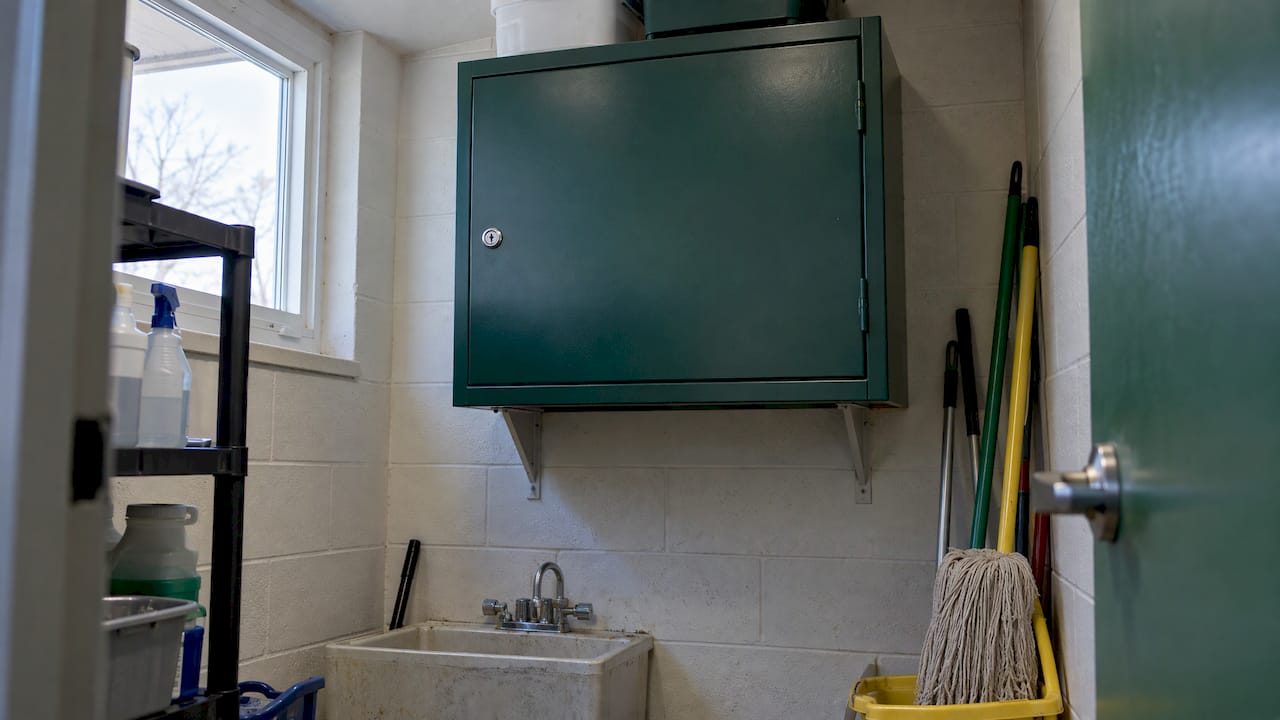
Two practical points follow. First, because inspections are unannounced, the cleaning plan has to hold up on any given day, not only the day before you expect a visit. Second, product storage is part of your responsibility even when a contractor brings the supplies, so agree on where the crew keeps them and who locks them away. For the exact current wording and for home daycares versus centers, check the rules with your licensing contact.
Products and methods that are safe around children
The product choice matters as much as the schedule. The guidance from official sources is consistent:
- EPA registration. Wisconsin’s child care publication states that all sanitizers and disinfectants used in child care must be EPA-registered, and that bleach is the most commonly used product for this purpose.
- Safer ingredients. The Washington State Department of Health suggests products with EPA Design for the Environment certification or active ingredients such as ethanol, isopropyl alcohol, hydrogen peroxide, lactic acid or citric acid, and fragrance-free bleach solutions.
- Label discipline. Read the label for contact time, dilution, rinsing and application. Iowa’s guidance tells users to pay attention to words like Warning or Danger and to follow the manufacturer’s dwell time.
- Fragrance and ventilation. The Head Start schedule, citing CDC advice, points to products free of fragrances and dyes and to opening windows or doors to ventilate while cleaning.
- Cloths and tools. Head Start prefers microfiber cloths and does not recommend cotton cloths, cotton mops or sponges.
- Storage. Chemicals stay locked up and out of children’s reach. Working containers of sanitizing solution must be labeled and used within the time frame in the manufacturer’s instructions, per Wisconsin’s guidance.
One more safety point from Washington: children should not be the ones using sanitizers or disinfectants. Keep children out of any room while products are applied and dried.
If your plan calls for bleach, mix it per the label or your state’s published ratio. Minnesota, for example, specifies at least two teaspoons of chlorine bleach per quart of water for diaper changing surfaces under its rules. Ratios vary by product and state, so follow the one in your licensing guidance.
How to choose a daycare cleaning service
Start with what a daycare is, which is a place where many small children share surfaces, floors and air for hours. The questions below separate a careful provider from a general-purpose one.
Check people and protection
You are handing over a building where children spend their day. Ask whether the crew is background-checked and whether the company carries insurance. Ask whether the same people come each visit, because a familiar crew learns your layout, your nap rooms and your storage rules.
Ask for a written scope
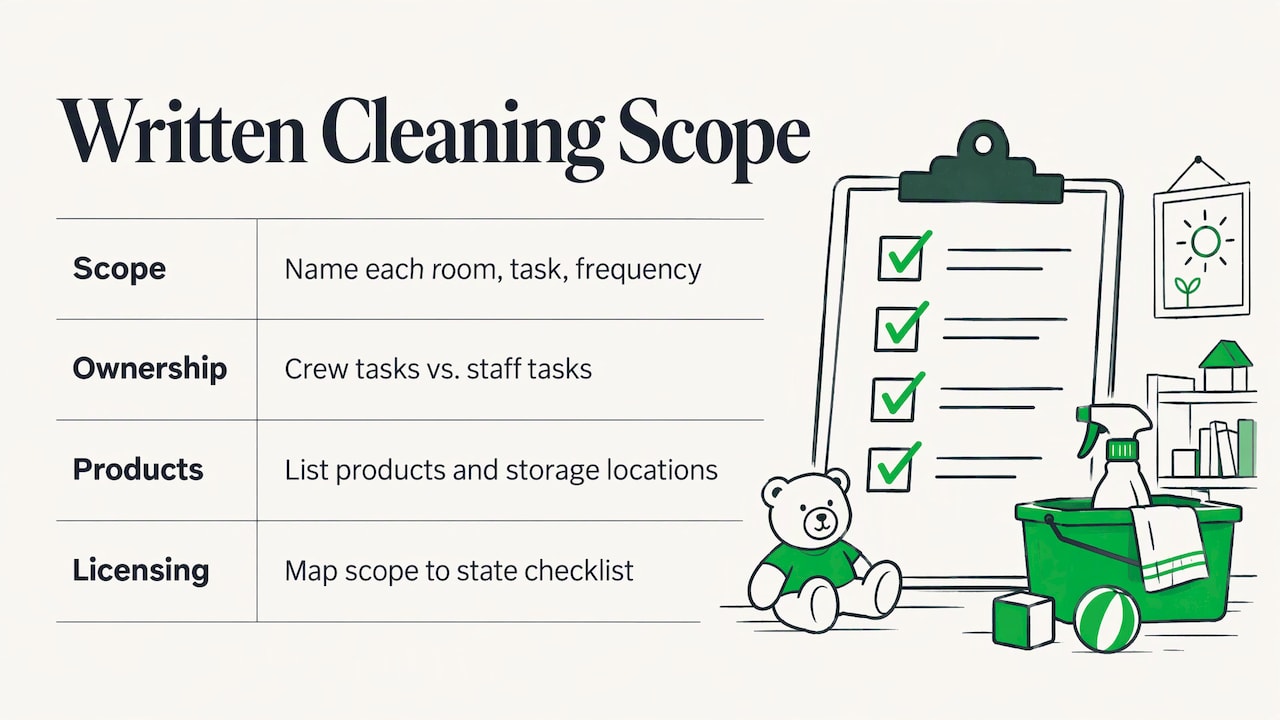
A scope names each room, each task and each frequency. It should state which tasks the crew owns and which stay with your staff. It should also say which products the crew will use and where they are stored. ChildCareComp notes that a cleaning contract should match the state’s licensing sanitation rules, or the facility risks a citation at inspection. Hand your provider your licensing checklist and ask them to map the scope to it.
Look for proof of work
A checklist signed after each visit and photos of the finished work give you a record. That record is useful when a parent asks a question, when a licensing visit happens, or when you want to confirm a task was done on a night you were not there.
Understand what drives the price
Pricing for daycare cleaning follows a few variables:
- Square footage and number of rooms, including how many restrooms and diapering areas.
- Visit frequency, from weekly for a small home daycare to daily for a larger center.
- Carpet, especially in nap and infant rooms, which adds periodic steam cleaning.
- Deep cleans, usually quoted separately from routine visits.
- Product requirements, since fragrance-free or certified products can differ in cost from standard supplies.
Because scope drives the number, any quote you receive without a walk-through or a detailed description is a guess. Ask for the scope in writing and compare like with like.
Perspective
We approach a space where children spend their day the way we approach any home or workplace we are trusted with: with a checklist, a consistent crew and photos so you can see what was done. Our teams are insured and background-checked, and we send the same crew when possible, because consistency is what turns a clean building into a dependable one.
What we hear most from owners and directors is that they do not want to supervise cleaning. They want to know it happened. That is why we work from a clear checklist, take before-and-after photos, and stand behind each visit with a 48-hour guarantee: if something was missed, we come back and re-clean it.
Our advice is to bring your licensing rules and your own daily routine to the first conversation. Tell us which tasks your staff will keep during the day, and we will build the after-hours scope around the rest, from restrooms and floors to deep cleans and carpets.
Ross
Cleaning for Treasure Valley childcare spaces with Eagle Ridge
We serve homeowners, landlords, property managers and businesses across Boise, Meridian, Eagle and the surrounding Treasure Valley. For a childcare space, the closest fit is our commercial cleaning service, built around the scope you set, with insured, background-checked teams, a photo-based checklist and a 48-hour satisfaction guarantee.
If you also run a childcare program out of a home, our recurring cleaning is available without a long-term contract for residential services. Pricing is set by service scope and frequency, so the best next step is to reach out through our site with your square footage, rooms and the schedule you need. If you are comparing office-style cleaning with what a childcare setting requires, our guide to corporate office cleaning explains how we scope recurring commercial work.
Building the plan: a simple five-step process
- Pull your licensing rules. Collect the sanitation sections from your state rules and any checklist your licensing office provides. In Idaho, start with the Department of Health and Welfare’s child care licensing rules.
- Walk the space at closing time. Note every room, restroom, diapering area, kitchen, nap area and carpeted zone, plus anything children touch constantly.
- Divide the tasks. Put daytime items (diaper changes, meal cleanup, mouthed toys) with your staff. Put end-of-day and periodic items (restrooms, floors, trash, carpets, deep cleans) with the crew.
- Settle products and storage. Agree on fragrance-free or certified products, who supplies them, where they are stored, and how working solutions are labeled.
- Set the record. Decide how completed work is documented: a signed checklist, photos, or both. Keep records where you can reach them on an inspection day.
Revisit the plan after the first month. Illness season, a new infant room or a change in enrollment can all change what the schedule should be.
FAQ
How often should a daycare be professionally cleaned?
That depends on your size and your state’s rules. Federal Head Start guidance calls for restrooms, diapering areas and floors to be cleaned at the end of each day, so many centers schedule nightly or near-nightly visits. Smaller home programs may use weekly visits and handle daily tasks themselves.
What do daycares clean with?
Most use EPA-registered sanitizers and disinfectants, with bleach solutions the most common choice according to Wisconsin’s child care guidance. Many programs also choose fragrance-free or third-party-certified products, and microfiber cloths, as recommended by Head Start. Always follow the label for contact time and dilution.
Does a daycare cleaning company need to know my state’s licensing rules?
Yes. Rules differ, and your inspector will check against yours. Give the provider your licensing checklist so the written scope matches it. In Idaho, health inspections of licensed daycares are annual and unannounced.
How is daycare cleaning priced?
By scope and frequency: square footage, number of restrooms, visits per week, carpet and deep cleans. We price our work by service scope and frequency, so we quote after learning your space and schedule rather than from a flat rate.
Sources
- Schedule for Cleaning, Sanitizing, and Disinfecting, Head Start
- How To Clean and Disinfect Early Care and Education Settings, CDC
- Guidelines for a Clean and Healthy Child Care Environment, Washington DCYF
- Cleaning, Disinfecting and Sanitizing Guidelines, Arizona Department of Health Services
- Guide to Child Care, South Dakota Department of Social Services
- IDAPA 16.06.02 Child Care Licensing, Idaho Department of Health and Welfare
- Cleaning, Sanitizing, and Disinfecting in Child Care, Wisconsin DCF
- Cleaning, Sanitizing, and Disinfecting for Child Cares, Washington State Department of Health
- Appendix J: Selection and Use of a Cleaning, Sanitizing, or Disinfecting Product, Iowa HHS
- Evaluation of Cleaners, Sanitizers, and Disinfectants, Minnesota Department of Health
- Daycare cleaning contracts, ChildCareComp