
Post-Renovation Cleaning Service: What It Covers and How to Book
A post-renovation cleaning service removes the fine dust, residue and leftover mess that builders leave behind, so your remodeled kitchen, bath or whole house is ready to live in. It goes well beyond a routine clean: crews work top to bottom, wipe surfaces the dust has settled on, and detail the places a regular visit never touches. If you live in the Treasure Valley, we can help with a one-time or deep clean once your contractor hands the keys back.
TL;DR
- Post-renovation cleaning is a detailed, top-to-bottom clean done after the contractor finishes, not a standard maid visit.
- Expect three stages in a large project: rough clean during work, final clean before move-in, and a touch-up after the punch list closes.
- Schedule the clean after trades are done and the punch list is nearly closed, so dust is not stirred up again.
- Homes built before 1978 and jobs that created silica dust carry real safety rules for the people doing the work. Ask your contractor about them.
- Judge a cleaner on scope in writing, insurance, background checks, and a clear guarantee.
Table of Contents
- What post-renovation cleaning actually is
- What a professional crew typically cleans after a remodel
- The three stages: rough, final and touch-up
- Safety: dust, lead and silica
- How to prepare your home for the cleaning crew
- Perspective
- How to choose a reliable post-renovation cleaner
- What affects the price
- Booking us after your renovation
- Common mistakes after a remodel
- FAQ
- Sources
What post-renovation cleaning actually is
A remodel makes a different kind of mess than daily life. Drywall sanding, tile cutting, demolition and painting create fine particles that float, drift into other rooms, and settle on every flat surface, inside cabinets, in vents and along baseboards. Routine house cleaning is built for kitchen grease, bathroom buildup, and household dust. Post-renovation work is built for construction residue.
The practical differences:
- Time. A post-renovation clean takes longer than a regular visit for the same square footage, because surfaces need several passes: dry dust removal first, then wet cleaning.
- Method. Dust is removed from the top down (ceiling fixtures, walls, shelves, then floors) so nothing falls onto work already done.
- Detail. Inside drawers, door tracks, window channels, light fixtures and vent covers get attention, since this is where fine dust hides and later reappears.
- Scope. The goal is a space you can unpack into, not a space that is simply tidy.
The same logic applies to new construction. A newly built house has never been lived in, but it has been through months of trades, and the dust and residue are the same.
What a professional crew typically cleans after a remodel
Scopes differ from provider to provider, so always confirm yours in writing. A thorough post-remodel clean generally covers:
Surfaces and fixtures
- Wiping down walls, trim, baseboards, door frames and window sills
- Cleaning light fixtures, ceiling fans and switch plates
- Polishing faucets, sinks, tubs, showers and mirrors
- Removing paint specks, stickers and protective film where it can be done safely without damaging finishes
Kitchen and bath
- Cabinet exteriors and, ideally, interiors and drawers
- Countertops and backsplashes
- Appliance exteriors, plus oven and fridge interiors as add-ons
- Grout lines and tile surfaces
Windows, vents and floors
- Interior window glass, tracks and frames
- Vent covers and accessible registers
- Vacuuming and mopping hard floors, vacuuming carpet and stairs
Heavy debris is a different job. Hauling away lumber, drywall scraps, packaging and tools is normally the contractor’s responsibility and should be settled in your renovation contract. A cleaning crew arrives after that to handle the fine cleaning.
The three stages: rough, final and touch-up
Large projects, especially new builds and whole-home renovations, are usually cleaned in stages. Smaller jobs, like a single bathroom, often need only the final clean.
| Stage | When | Purpose |
|---|---|---|
| Rough clean | During construction, between trades | Keeps the site safe and workable: sweeping, debris pickup, clearing paths |
| Final clean | After major work is done, before you move back in | Makes the home presentable, safe and livable: the detailed top-to-bottom clean |
| Touch-up clean | After the punch list is closed | Handles dust and marks left by last-minute fixes, inspections or final trades |
For most homeowners the final clean is the one you book yourself. Rough cleaning is usually coordinated by the contractor, and a touch-up is a short follow-up when the last repairs are completed.
When to schedule the final clean
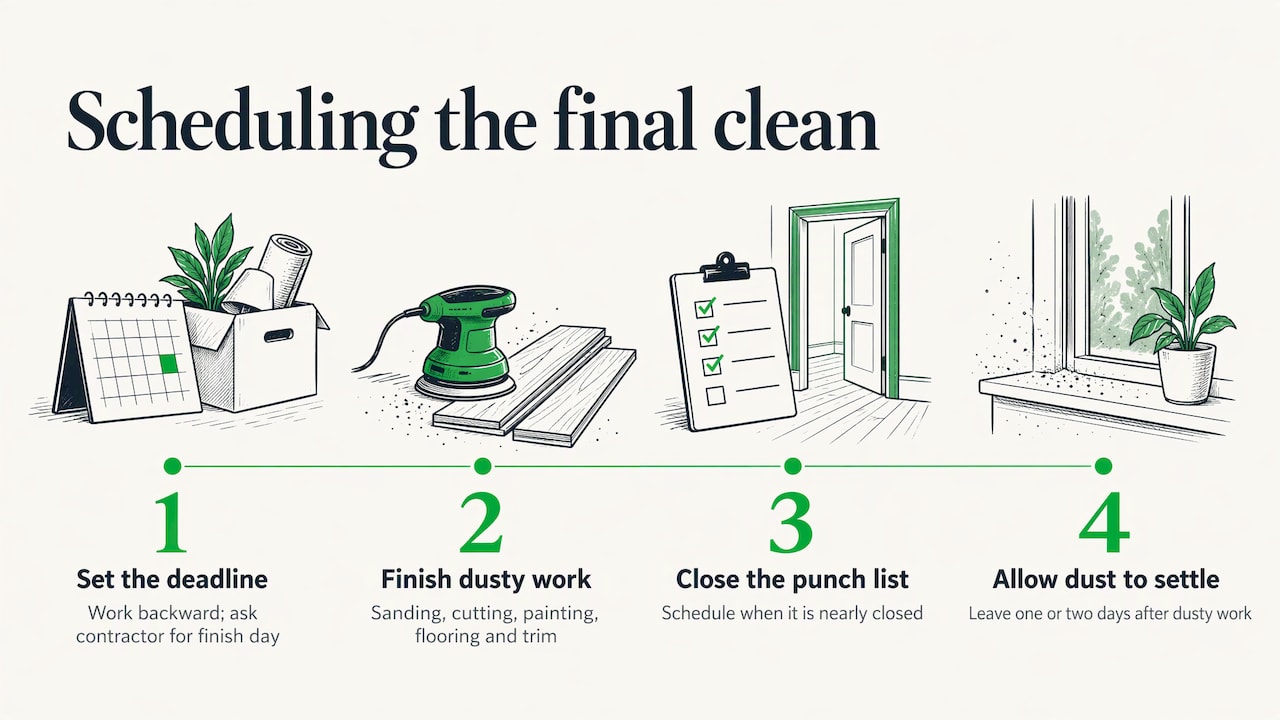
Book it when the heavy, dusty work is truly finished: sanding, cutting, painting, flooring and trim. Cleaning before the painter touches up or the electrician returns means doing it twice. A good rule is to schedule it once the punch list is nearly closed, and leave a day or two between the last dusty task and the clean so airborne dust has time to settle. Then remove it once, properly.
If you are on a deadline, such as a move-in date, a listing photo shoot or a tenant arriving, work backward from that date and ask your contractor for the realistic finish day.
Safety: dust, lead and silica
Renovation dust is not only a nuisance. Two issues deserve attention, and both are mainly about how the renovation itself is run.
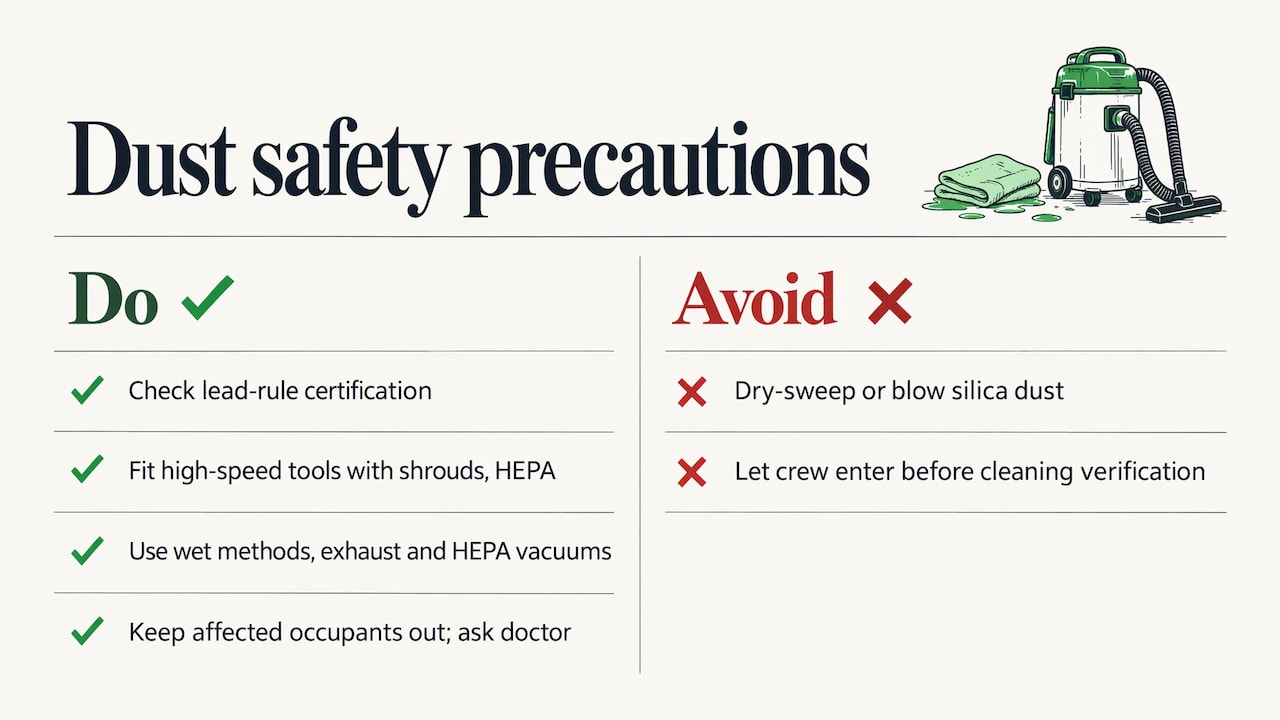
Older homes and lead paint. For paid renovations that disturb paint in homes built before 1978, the EPA’s Renovation, Repair and Painting rule requires containment and a cleaning verification step. It also requires that high-speed tools use shrouds or containment along with HEPA vacuum attachments. If your Boise-area home predates 1978, ask your contractor whether they are certified under this rule and how cleaning verification will be done, before any cleaning crew enters.
Silica dust. Cutting or grinding concrete, stone, tile and some masonry can release respirable crystalline silica. OSHA’s compliance guide for the silica standard says covered employers must use feasible engineering and work-practice controls, with wet methods, local exhaust and HEPA vacuuming as examples. That is a good reason never to dry-sweep or blow dust around a finished room, and to expect a cleaner to use damp wiping and filtered vacuums.
If anyone in your household has asthma, allergies or a respiratory condition, keep them out of the house until the final clean is done, and ask their doctor about when it is safe to return.
How to prepare your home for the cleaning crew
A little preparation makes the visit faster and the result better.
- Confirm the work is finished. Walk through with your contractor and settle the punch list first.
- Make sure debris is gone. Construction waste, leftover materials and tools should be hauled out.
- Clear the space. Move boxes, furniture and décor out of the way, or into rooms that are cleaned last.
- Remove protective coverings. Floor paper, plastic sheeting and cabinet films are easiest to pull with the contractor’s guidance on what should stay until final inspection.
- Turn on utilities. Running water, electricity and heat or cooling should work.
- Arrange access. Share lockbox or garage codes, parking notes and pet information.
- List your priorities. Tell the crew about dusty spots, stubborn residue, delicate finishes like unsealed stone or new hardwood, and anything you want included such as the oven or fridge.
Landlords turning over a renovated rental should add a final walkthrough with photos before the crew arrives, so there is a clear record of the property’s condition.
Perspective
Most people think the hard part of a remodel ends when the contractor drives away. It doesn’t. The last stretch is the part you see and touch every day, and it is where small misses annoy you for months: a film of dust on the top shelf, a smear on a new window, grit in a drawer.
Our approach is to treat that last stretch like a handoff. Our teams are insured and background-checked, we work from a clear checklist, and we take before-and-after photos so you can see what was done. We keep the same crew on your home when possible, because a team that knows the house cleans it better the second time.
We also stand behind the work with a 48-hour guarantee: if something was missed, tell us and we re-clean it. For a home that has just been through a renovation, that kind of accountability is what lets you finally unpack and relax.
Ross
How to choose a reliable post-renovation cleaner
The cheapest quote is rarely the thorough one. Compare providers on these points:
- A written scope. It should name rooms, surfaces and whether cabinet interiors, vents, window tracks and appliances are included.
- Insurance. Your home just got new finishes. You want a crew whose work is covered if something is damaged.
- Vetted staff. Ask whether team members are background-checked, since they will be alone in a finished home.
- A checklist and photos. Documentation shows what was cleaned and gives you something to refer to.
- A guarantee. Look for a clear, time-limited promise to return and fix misses.
- Communication. You should know who is coming, when, and how to reach them.
- Method. Ask how they handle fine dust: damp wiping, filtered vacuums, top-to-bottom order.
A crew that cleans only what you can see in photos may skip what you will notice in a week. Choose the one that explains the process.
What affects the price
Post-renovation cleaning is priced by the job, not a flat hourly guess. These factors move the quote the most:
- Square footage and layout. More rooms, stairs and windows mean more time.
- Amount of dust and residue. A paint refresh is very different from a gut remodel with tile cutting and drywall work.
- Type of work done. Kitchens and baths have more detail surfaces: cabinets, grout, fixtures.
- Number of cleaning passes. Heavy dust may need a second visit or a touch-up.
- Add-ons. Oven, fridge, interior cabinets and windows add scope.
- Timing. Tight deadlines and last-minute bookings can limit availability.
We price by service scope and frequency, and we don’t publish a flat rate because every renovation leaves a different amount of work. Share photos and the details of your project and we will quote it for your actual home. Residential service has no subscription or long-term contract.
Booking us after your renovation
We serve Boise, Meridian, Eagle and the wider Treasure Valley. For a freshly renovated home, most clients book a one-time cleaning or a deep cleaning with add-ons such as the oven, fridge and cabinets. Landlords preparing a unit for new tenants can use our move-in and move-out cleaning.

Each visit comes with a photo-based checklist and a 48-hour satisfaction guarantee. Once the dust is gone, a recurring cleaning plan keeps the new space the way your contractor left it. To get a quote, start at Eagle Ridge Cleaning.
Common mistakes after a remodel
- Cleaning too early. Dust settles again if trades are still working. Wait for the last dusty task.
- Dry sweeping or using a household vacuum on fine dust. This pushes particles back into the air. Damp wiping and filtered vacuums are better.
- Using harsh cleaners on new finishes. Natural stone, new hardwood and fresh paint can be damaged by the wrong product. Check the manufacturer’s care instructions.
- Forgetting hidden spots. Vents, tracks, the tops of cabinets and the insides of drawers collect the most dust.
- Skipping the HVAC. Dust in the system recirculates. Ask your contractor or an HVAC professional about replacing filters after the work.
- Expecting the cleaner to haul debris. Settle this in the renovation contract.
FAQ
How long after a renovation should I schedule cleaning?
Schedule it once the dusty work is complete and the punch list is nearly closed. Leaving a day or two after the last sanding, cutting or painting lets airborne dust settle so it is removed in one pass. Larger projects may also need a short touch-up visit after final repairs.
Is post-renovation cleaning the same as a deep clean?
They overlap, but they are not identical. A deep clean focuses on built-up grime in a lived-in home, while post-renovation cleaning targets construction dust and residue on new surfaces. For a remodeled home, a deep clean with the right add-ons is a common way to cover it.
Will the cleaners remove construction debris?
Usually not. Lumber, drywall scraps and packaging are normally the contractor’s job to remove. A cleaning crew arrives afterward for fine dust, surfaces, fixtures and floors, so confirm debris removal in your renovation contract.
Do I need to leave the house during the cleaning?
You don’t have to be present if you arrange access, but many people prefer to be away during a dusty clean. If anyone in your home has asthma or allergies, keep them out until the work is done and ask their doctor when it is safe to return.
Do you offer long-term contracts for residential cleaning?
No. Our residential services have no subscription or long-term contract. You can book a one-time clean after your renovation and add recurring visits later if you want.
Sources
- LEAD SAFE Renovation, Repair and Painting (EPA)
- Small Entity Compliance Guide for the Respirable Crystalline Silica Standard (OSHA)