Corporate Office Cleaning: What to Expect and How to Choose
Corporate office cleaning is a scheduled, written scope of work: daily upkeep of desks, restrooms, break rooms and floors, plus less frequent detail and project tasks like high dusting and carpet extraction. The right provider puts that scope in writing, fits it around your workday and shows you proof it was done. This guide explains what belongs in the scope, how often each area needs attention, how pricing is built, and what to check before you sign with a cleaning team in the Treasure Valley.
TL;DR
-
A solid office cleaning plan has three layers: daily tasks, detail work and periodic projects, each with its own schedule.
-
Frequency should follow touch, traffic and visible soil, not a fixed calendar. The CDC recommends regular cleaning of high-touch surfaces and targeted disinfection when illness is evident.
-
Price depends on square footage, task mix and visit frequency. Expect a quote built from a walkthrough, not a flat number.
-
Ask for a building-specific written plan, proof of insurance, background-checked staff and a clear way to report a missed spot.
-
Our teams at Eagle Ridge Cleaning are insured and background-checked, use photo-based checklists and back each visit with a 48-hour guarantee.
Table of Contents
What corporate office cleaning actually includes
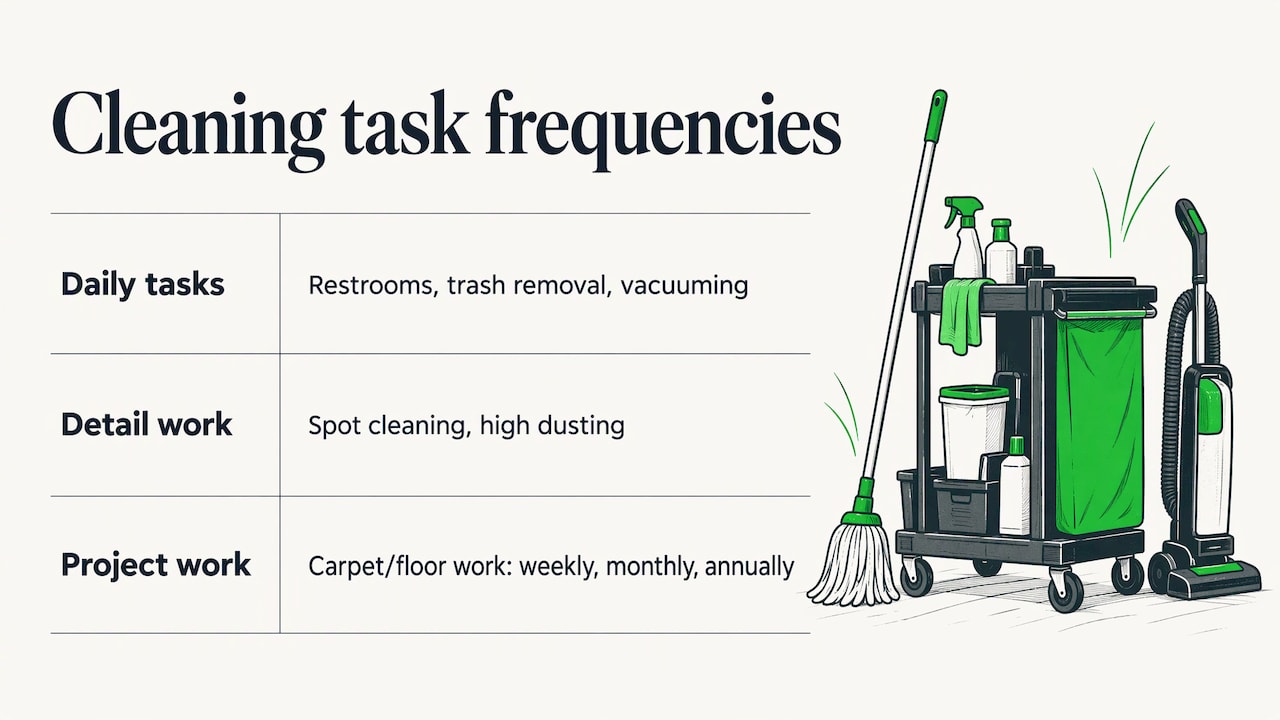
A professional scope of work is usually organized by how often each task happens. ISSA, the cleaning industry association, describes three frequency categories: daily tasks such as restroom cleaning, trash removal and vacuuming; detail work such as spot cleaning and high dusting; and project work such as carpet extraction and floor stripping, performed weekly, monthly or annually.
In a typical corporate office, that translates into the following.
Daily tasks
-
Emptying trash and recycling bins and replacing liners
-
Vacuuming carpets and dust-mopping or damp-mopping hard floors
-
Cleaning and restocking restrooms: toilets, sinks, mirrors, floors, soap and paper
-
Wiping break room counters, tables, sinks and the outside of appliances
-
Wiping reception desks, conference tables and other shared surfaces
-
Cleaning high-touch points such as door handles, elevator buttons, light switches and shared equipment
Detail work
-
Dusting vents, ledges, blinds, monitors and the tops of cabinets
-
Spot cleaning walls, glass partitions and entry doors
-
Cleaning inside microwaves and refrigerators in the break room
-
Detailing baseboards and corners that daily passes skip
Project work
-
Carpet extraction and upholstery cleaning
-
Floor scrubbing, stripping and refinishing on hard surfaces
-
Deep restroom and kitchen cleaning
-
Interior window washing
Project work does not have to be bundled with daily service. Many offices book daily or weekly visits and add projects quarterly or before a client event. If you want both kinds of work from one team, our office cleaning service and commercial cleaning service cover them.
Office cleaners, janitors and commercial cleaning: what the terms mean
People search for “office cleaners,” “janitors” and “commercial cleaning” as if they were the same thing. They overlap, but the words signal different expectations.
In American English, Collins defines a janitor as someone employed in an office building or similar place to clean public areas, remove garbage and do minor repairs. The U.S. Department of Labor’s O*NET profile for janitors and cleaners adds that the work can include heavy floor cleaning, rug shampooing, washing walls and glass, rubbish removal, routine maintenance and reporting needed repairs.
In practice:
-
Janitorial service is the recurring layer: the daily or several-times-a-week upkeep that keeps an office presentable and the restrooms stocked. See our janitorial cleaning service.
-
Commercial cleaning is the broader term. It includes janitorial upkeep and also the periodic deep work that needs more time or equipment.
-
Corporate office cleaning is commercial cleaning applied to an office setting, usually with a defined schedule, a point of contact and some form of reporting.
When you request quotes, describe the tasks you want rather than relying on a label. “Nightly trash, restrooms, vacuuming and break room, plus carpet cleaning twice a year” gets you a comparable quote from every provider.
How often each area should be cleaned
There is no single correct calendar. The CDC’s guidance on cleaning and disinfecting a facility says to clean high-touch surfaces regularly, clean other surfaces when they are visibly dirty, and disinfect areas where people have obviously been ill. High-traffic areas may need more frequent cleaning or added disinfection. In other words, frequency should follow how much a space is touched, how much traffic it sees and whether there is visible soil or illness.
Here is a practical starting point built on that logic. Adjust it to your headcount and layout.
| Area | Typical starting frequency | Why |
|---|---|---|
| Restrooms | Daily | Highest-touch, highest-expectation space |
| Break room and kitchenette | Daily | Food residue and shared surfaces |
| Reception and lobby | Daily | First impression, heavy foot traffic |
| Workstations and desks | Weekly deep wipe, or daily if desks are shared | Personal items limit what cleaners can touch |
| Conference rooms | After heavy use or daily | Shared tables, chairs and equipment |
| Entry doors and glass | Weekly | Fingerprints and smudges build up fast |
| High dusting and vents | Monthly or quarterly | Dust settles slowly but visibly |
| Carpet extraction | Once or twice a year, more in high-traffic lanes | Removes embedded soil vacuuming misses |
| Hard floor scrubbing and refinishing | Quarterly to annually | Depends on traffic and floor type |
Treasure Valley adds a seasonal factor. Winter grit and dried mud tracked in from parking lots wear on entry flooring, and dry weather means more dust. If your lobby sees heavy foot traffic from clients, plan extra floor attention in the colder months.
A note on disinfecting: the CDC’s perspective is that regular cleaning is generally sufficient, with targeted disinfection when illness is evident. When someone has been sick at work, tell your cleaning provider so they can disinfect the affected spaces, rather than asking for blanket disinfection every night.
How office cleaning is priced
Reputable providers do not price an office from a rate card. They price it from the work. The ISSA workloading method estimates cost by calculating task hours from the cleanable area and task production rates, multiplying annual hours by wage rates, and then adding taxes, insurance, benefits, supplies, equipment depreciation, overhead, administration and profit. ISSA also recommends dividing square footage by task-specific production rates and multiplying by annual frequency to find total staffing needs.
You do not need to run those numbers yourself, but it helps to know what drives your quote:
-
Square footage of cleanable area. Not the lease size. Storage rooms, server closets and areas you do not want cleaned reduce the total.
-
Floor types. Carpet, vinyl, tile and polished concrete each take different time and equipment.
-
Number of restrooms and fixtures. Restrooms are the most labor-intensive part of a daily visit.
-
Visit frequency. Five nights a week costs more per month than two, though the per-visit price usually drops as frequency rises because setup time is spread out.
-
Task mix. Daily upkeep, detail work and project work are priced differently.
-
Timing. After-hours cleaning is common because it avoids disrupting staff, and it can affect scheduling and rates.
-
Supplies. Whether the provider supplies paper, soap and liners or you do.
We do not publish flat rates for office work, because two 3,000 square foot offices can need very different scopes. We quote after learning the layout, the schedule and your priorities. That is also how you should evaluate anyone else: be wary of a quote given without asking about square footage, restrooms and frequency.
What to look for in a corporate office cleaning company
Use this checklist when comparing providers.
A building-specific written plan
The Green Seal cleaning services guidebook (2024) describes a written cleaning plan specific to the building. It covers procedures for cleaning and waste collection, product handling and storage, equipment operation and maintenance, disposal, and communication with management and occupants, along with schedules and building details. The same guidebook says schedules should be reviewed at least twice a year and the plan at least once a year. Ask any provider to show you their version of this document for your space.
Trained people
Green Seal also points to personnel trained in regulatory compliance and clear procedures for managing hazardous materials. Ask who is on the crew, how they are trained and how chemical products are labeled and stored.
Insurance and background checks
Your cleaners will be in your building after hours, near computers, files and cash drawers. Ask for proof of insurance and confirm that staff are background-checked. Our crews are insured and background-checked.
Consistency
A different crew every night means no one learns your building. Ask whether the provider assigns the same team where possible. We do, when scheduling allows.
Proof of work
A checklist is only useful if someone confirms it. We use photo-based checklists and take before-and-after photos, so you can see what was done without being there at 9 p.m.
A clear fix for missed spots
Every cleaning service misses something occasionally. What matters is the response. Ask for the guarantee in writing. Ours is a 48-hour guarantee: if something on the agreed scope was missed, tell us and we re-clean it.
Flexible terms
For residential work we have no subscription or long-term contract. For commercial work, ask any provider what the contract term, notice period and scope-change process look like before you sign.
Questions to ask before you sign
-
Can you walk the space and give me a written scope and quote?
-
Which tasks are daily, which are weekly, and which are periodic projects?
-
Who supplies restroom paper, soap and trash liners?
-
How will I know the work was done each visit?
-
What happens if something is missed, and how fast do you respond?
-
Will the same team clean my office each time?
-
Can you adjust frequency after a month if the schedule is too much or too little?
-
Who is my single point of contact?
A provider who answers these clearly and in writing is usually one who runs consistent operations.
A sample scope for a mid-size office
To make this concrete, here is how a scope might look for a one-floor professional office with an open work area, two restrooms, a break room, a reception area and two conference rooms. This is an illustration of structure, not a quote.
Three or five evenings a week
-
Empty all trash and recycling
-
Vacuum carpet and mop hard floors in lobby, break room and restrooms
-
Clean and restock restrooms
-
Wipe break room surfaces and appliance exteriors
-
Wipe reception desk, conference tables and high-touch points
Weekly
-
Wipe workstation surfaces that are clear of personal items
-
Clean entry glass and interior glass partitions
-
Detail baseboards in high-traffic areas
Monthly or quarterly
-
High dusting of vents, ledges and blinds
-
Clean inside break room refrigerator and microwave
Once or twice a year
-
Carpet extraction
-
Hard floor scrub and refinish
Writing the scope this way lets you compare providers line by line and makes any change, like adding a night or dropping the quarterly project, easy to price.
Our perspective
Most offices we talk to do not need more cleaning. They need cleaning that is predictable. The same crew, the same checklist, and photos that show what changed since yesterday.
We built our approach around accountability. Insured, background-checked teams, clear checklists, before-and-after photos and a 48-hour guarantee mean you do not have to wonder whether the work happened. If something is missed, we come back.
Start with a walkthrough and a written scope. Daily upkeep keeps the space presentable, and periodic projects keep floors and carpets from wearing out early. Adjust as you learn how your team uses the space.
Ross
Cleaning your Treasure Valley office with Eagle Ridge
We provide office cleaning, commercial cleaning and janitorial services for businesses across the Treasure Valley, with recurring schedules built around your hours. Each visit follows a checklist, is documented with photos and is covered by our 48-hour guarantee.
To get a quote, start with our office cleaning page and tell us about your space, your schedule and the areas that matter most. If you manage rental property or need a one-time reset, see our commercial cleaning options too.
FAQ
How much does corporate office cleaning cost?
It depends on cleanable square footage, floor types, restroom count, visit frequency and the task mix. Industry practice, as ISSA describes, is to estimate task hours and then add labor, insurance, supplies and overhead. We quote office work after learning your layout and schedule.
What is someone who cleans offices called?
The most common American term is janitor, which Collins defines as a person who cleans public areas and removes garbage in places like office buildings. You will also hear office cleaner, custodian or commercial cleaner. Providers often use janitorial service for the recurring upkeep.
How often should an office be cleaned?
High-touch surfaces and restrooms need regular, usually daily, cleaning, while other areas can follow visible soil and traffic, as the CDC advises. Many offices choose three to five visits a week and add periodic projects like carpet cleaning. Review the schedule after the first month.
What is the difference between janitorial and commercial cleaning?
Janitorial service is the routine upkeep: trash, vacuuming, restrooms and surface wiping. Commercial cleaning is the broader category that also covers periodic project work such as floor scrubbing and carpet extraction. Most offices use a mix, which our janitorial and commercial teams can combine.